Automated essay scoring (AES) is the use of specialized computer programs to assign grades to essays written in an educational setting. It is a form of educational assessment and an application of natural language processing. Its objective is to classify a large set of textual entities into a small number of discrete categories, corresponding to the possible grades, for example, the numbers 1 to 6. Therefore, it can be considered a problem of statistical classification. Several factors have contributed to a growing interest in AES. Among them are cost, accountability, standards, and technology. Rising education costs have led to pressure to hold the educational system accountable for results by imposing standards. The advance of information technology promises to measure educational achievement at reduced cost. The use of AES for high-stakes testing in education has generated significant backlash, with opponents pointing to research that computers cannot yet grade writing accurately and arguing that their use for such purposes promotes teaching writing in reductive ways (i.e. teaching to the test). == History == Most historical summaries of AES trace the origins of the field to the work of Ellis Batten Page. In 1966, he argued for the possibility of scoring essays by computer, and in 1968 he published his successful work with a program called Project Essay Grade (PEG). Using the technology of that time, computerized essay scoring would not have been cost-effective, so Page abated his efforts for about two decades. Eventually, Page sold PEG to Measurement Incorporated. By 1990, desktop computers had become so powerful and so widespread that AES was a practical possibility. As early as 1982, a UNIX program called Writer's Workbench was able to offer punctuation, spelling and grammar advice. In collaboration with several companies (notably Educational Testing Service), Page updated PEG and ran some successful trials in the early 1990s. Peter Foltz and Thomas Landauer developed a system using a scoring engine called the Intelligent Essay Assessor (IEA). IEA was first used to score essays in 1997 for their undergraduate courses. It is now a product from Pearson Educational Technologies and used for scoring within a number of commercial products and state and national exams. IntelliMetric is Vantage Learning's AES engine. Its development began in 1996. It was first used commercially to score essays in 1998. Educational Testing Service offers "e-rater", an automated essay scoring program. It was first used commercially in February 1999. Jill Burstein was the team leader in its development. ETS's Criterion Online Writing Evaluation Service uses the e-rater engine to provide both scores and targeted feedback. Lawrence Rudner has done some work with Bayesian scoring, and developed a system called BETSY (Bayesian Essay Test Scoring sYstem). Some of his results have been published in print or online, but no commercial system incorporates BETSY as yet. Under the leadership of Howard Mitzel and Sue Lottridge, Pacific Metrics developed a constructed response automated scoring engine, CRASE. Currently utilized by several state departments of education and in a U.S. Department of Education-funded Enhanced Assessment Grant, Pacific Metrics’ technology has been used in large-scale formative and summative assessment environments since 2007. Measurement Inc. acquired the rights to PEG in 2002 and has continued to develop it. In 2012, the Hewlett Foundation sponsored a competition on Kaggle called the Automated Student Assessment Prize (ASAP). 201 challenge participants attempted to predict, using AES, the scores that human raters would give to thousands of essays written to eight different prompts. The intent was to demonstrate that AES can be as reliable as human raters, or more so. The competition also hosted a separate demonstration among nine AES vendors on a subset of the ASAP data. Although the investigators reported that the automated essay scoring was as reliable as human scoring, this claim was not substantiated by any statistical tests because some of the vendors required that no such tests be performed as a precondition for their participation. Moreover, the claim that the Hewlett Study demonstrated that AES can be as reliable as human raters has since been strongly contested, including by Randy E. Bennett, the Norman O. Frederiksen Chair in Assessment Innovation at the Educational Testing Service. Some of the major criticisms of the study have been that five of the eight datasets consisted of paragraphs rather than essays, four of the eight data sets were graded by human readers for content only rather than for writing ability, and that rather than measuring human readers and the AES machines against the "true score", the average of the two readers' scores, the study employed an artificial construct, the "resolved score", which in four datasets consisted of the higher of the two human scores if there was a disagreement. This last practice, in particular, gave the machines an unfair advantage by allowing them to round up for these datasets. In 1966, Page hypothesized that, in the future, the computer-based judge will be better correlated with each human judge than the other human judges are. Despite criticizing the applicability of this approach to essay marking in general, this hypothesis was supported for marking free text answers to short questions, such as those typical of the British GCSE system. Results of supervised learning demonstrate that the automatic systems perform well when marking by different human teachers is in good agreement. Unsupervised clustering of answers showed that excellent papers and weak papers formed well-defined clusters, and the automated marking rule for these clusters worked well, whereas marks given by human teachers for the third cluster ('mixed') can be controversial, and the reliability of any assessment of works from the 'mixed' cluster can often be questioned (both human and computer-based). == Different dimensions of essay quality == According to a recent survey, modern AES systems try to score different dimensions of an essay's quality in order to provide feedback to users. These dimensions include the following items: Grammaticality: following grammar rules Usage: using of prepositions, word usage Mechanics: following rules for spelling, punctuation, capitalization Style: word choice, sentence structure variety Relevance: how relevant of the content to the prompt Organization: how well the essay is structured Development: development of ideas with examples Cohesion: appropriate use of transition phrases Coherence: appropriate transitions between ideas Thesis Clarity: clarity of the thesis Persuasiveness: convincingness of the major argument == Procedure == From the beginning, the basic procedure for AES has been to start with a training set of essays that have been carefully hand-scored. The program evaluates surface features of the text of each essay, such as the total number of words, the number of subordinate clauses, or the ratio of uppercase to lowercase letters—quantities that can be measured without any human insight. It then constructs a mathematical model that relates these quantities to the scores that the essays received. The same model is then applied to calculate scores of new essays. Recently, one such mathematical model was created by Isaac Persing and Vincent Ng. which not only evaluates essays on the above features, but also on their argument strength. It evaluates various features of the essay, such as the agreement level of the author and reasons for the same, adherence to the prompt's topic, locations of argument components (major claim, claim, premise), errors in the arguments, cohesion in the arguments among various other features. In contrast to the other models mentioned above, this model is closer in duplicating human insight while grading essays. Due to the growing popularity of deep neural networks, deep learning approaches have been adopted for automated essay scoring, generally obtaining superior results, often surpassing inter-human agreement levels. The various AES programs differ in what specific surface features they measure, how many essays are required in the training set, and most significantly in the mathematical modeling technique. Early attempts used linear regression. Modern systems may use linear regression or other machine learning techniques often in combination with other statistical techniques such as latent semantic analysis and Bayesian inference. The automated essay scoring task has also been studied in the cross-domain setting using machine learning models, where the models are trained on essays written for one prompt (topic) and tested on essays written for another prompt. Successful approaches in the cross-domain scenario are based on deep neural networks or models that combine deep and shallow features. == Criteria for success == Any method of a
Companion robot
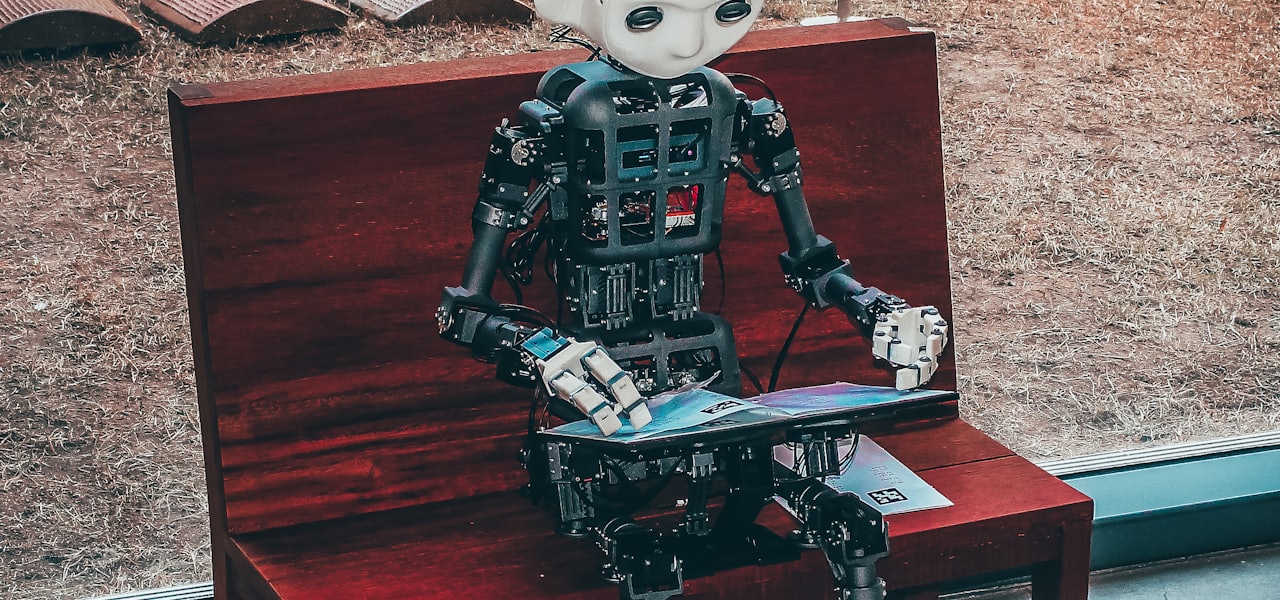
A companion robot is a robot created to create real or apparent companionship for human beings. Target markets for companion robots include the elderly and single children. Companions robots are expected to communicate with non-experts in a natural and intuitive way. They offer a variety of functions, such as monitoring the home remotely, communicating with people, or waking people up in the morning. Their aim is to perform a wide array of tasks including educational functions, home security, diary duties, entertainment and message delivery services, etc. The idea of companionship with robots has already existed on science fictions of 1970s, like R2-D2. Starting from the late 20th century, companion robots became a reality, mostly as robotic pets. Besides entertainment purposes, interactive robots were also introduced as a personal service robot for elderly care around 2000. == Characteristics == Companion robots try to interact with users. They gather information about users based on their interactions and yield feedback. This procedure varies slightly based on their specific roles. For example, social-companion robots make simple conversations, while pet-companion robots mimic being real pets. == Types == Companion robots can perform a variety of tasks and they are produced in a specialized manner according to their purpose or target audience in order to increase convenience and end user satisfaction. === Social companion robots === Social companion robots are designed to provide companionship and be a solution for unwanted solitude. They often mimic adult human, child or pet behaviours appealing to the user base. Robots which are specifically devised for simple conversations, conveying emotions and respond to user feelings fall under this category. === Assistive companion robots === Assistive companion robots are aimed at people who require constant care because of age, disability or rehabilitation purposes. Such robots can help disadvantaged users with their daily tasks, act as reminders (e.g., for regular medication) and facilitate mobility in everyday actions. Assistive companion robots reduce the intensity of labour that should be performed by caretakers, nurses and legal guardians. === Educational companion robots === Educational companion robots perform tutorship for students, regardless of their ages, and can teach desired subjects with activities tailored for the user such as interactive assignments and games. Rather than replacing teachers and instructors, educational companion robots are aides to them. === Therapeutic companion robots === Designed for individuals coping with stress (PTSD in severe cases), anxiety and loneliness; therapeutic companion robots support users' emotional and mental wellbeing. Such robots can be utilized in hospitals and care facilities as well as dwellings where the distressed user may need the most help. Therapeutic companion robots bear a vast resemblance to assistive companion robots to the extent of being a branch of them; the nuance between these two types of companion robots is that the former is for long-term/lifetime usage while the latter is mostly for the duration of the therapy received by the user. === Pet companion robots === Pet companion robots are for individuals who seek an alternative to live pets as live animals demand a considerable amount of care and may not be eligible for people with allergies. These robots aim to be perfect imitations of a pet while diminishing the chore aspect of having one. === Entertainment companion robots === Entertainment companion robots are designed solely for entertainment and can provide numerous ways of entertainment, ranging from dancing to playing games with the user. People who would appreciate an individual to have fun with are the main audience of such products. === Personal assistant robots === Personal assistant robots help people with daily tasks, management, scheduling, reminding etc. Their area of activity can be offices as well as homes and public spaces. === Sex robots === Sex robots are anthropomorphic robotic sex dolls that have human-like movement or behavior, and some degree of artificial intelligence. As of 2026, although elaborately instrumented sex dolls have been created by a number of inventors, no fully animated sex robots yet exist. Simple devices have been created which can speak, make facial expressions, or respond to touch. There is controversy as to whether developing them would be morally justifiable. In 2015, robot ethicist Kathleen Richardson called for a ban on the creation of anthropomorphic sex robots with concerns about normalizing relationships with machines and reinforcing female dehumanization. Questions about their ethics, effects, and possible legal regulations have been discussed since then. == Examples == There are several companion robot prototypes, and these include Paro, CompanionAble, and EmotiRob, among others. === Paro === Paro is a pet-type robot system developed by Japan's National Institute of Advanced Industrial Science and Technology (AIST). The robot, which looked like a small harp seal, was designed as a therapeutic tool for use in hospitals and nursing homes. The robot is programmed to cry for attention and respond to its name. Experiments showed that Paro facilitated elderly residents to communicate with each other, which led to psychological improvements. === CompanionAble === This robot is classified as an FP 7 EU project. It is built to "cooperate with Ambient Assistive Living environment". The autonomous device, which is also built to support the elderly, helps its owner interact with smart home environment as well as caregivers. The robot functions as a mobile friend, by which natural interaction is possible via speech and the touchscreen to detect and track people at home. === EmotiRob === EmotiRob is developed in a robotics project which is the continuity of the MAPH (Active Media For the Handicap) project in emotion synthesis. The aim of the project was to maintain emotional interaction with children. EmotiRob designed in a way that a child can hold it in a his/her arms and with which he/she could interact by talking to it, and then the robot would express itself through body postures or facial expressions. It has cognitive capabilities, which are further extended so that the robot can have a natural linguistic interaction with its owner through the DRAGON speech-recognition software developed by a company called NUANCE. Such interaction is expected to facilitate a child's cognitive development and develop new learning patterns. === LOVOT === Lovot is a Japanese company robot whose only purpose is "to make you happy". It features over 50 sensors that mimic the behavior of a human baby or small pet, a 360° camera with a microphone, the ability to distinguish humans from objects, neoteny eyes, and an internal warmth of 30° celsius. An interactive Lovot Café was opened in Japan October 3, 2020. === NICOBO === Nicobo was developed by Panasonic and was influenced by the loneliness of lockdowns created as a measure of the COVID-19 pandemic. It was designed to appear vulnerable, which creates empathy in its owners. Nicobo's name derives from the Japanese word for "smile". It wags its tail, engages in baby talk, and stays as a housemate. === Hyodol === Hyodol is an advanced care robot designed to support the elderly by reminding them to take their medications and monitoring their movements to keep their guardians informed. Additionally, this innovative robot can detect and respond to the emotional states of its elderly users, adding a layer of personalized care. Hyodol is designed with the appearance and speech style of a 7-year-old Korean grandchild, featuring a soft fabric exterior and user interaction methods such as striking the head or patting the back. It is equipped with various sensors and wireless communication technologies to collect and process data, supporting mobile apps and PC web monitoring systems for remote monitoring from anywhere. In South Korea, approximately 10,000 Hyodol robots are deployed to the homes of elderly individuals living alone, providing essential support and companionship. Local governments, including provincial and county offices, have embraced Hyodol as a solution to address social challenges stemming from the country's rapidly aging society.Furthermore, the robot is widely utilized in the treatment of dementia patients at a university hospital in Gangwon province. Hyodol was honored with the Mobile World Congress (MWC) Global Mobile Awards (GLOMO) in the "Best Mobile Innovation for Connected Health and Wellbeing" category on February 29, 2024. === Moxie === Moxie was a companion robot for autistic children developed by a company called Embodied. Although it had limited motion, it presented itself as a lifelike avatar. It was designed to help the children learn emotional cognition, using remotely hosted large language models to direct its respons
Nouvelle AI
Nouvelle artificial intelligence (Nouvelle AI) is an approach to artificial intelligence pioneered in the 1980s by Rodney Brooks, who was then part of MIT artificial intelligence laboratory. Nouvelle AI differs from classical AI by aiming to produce robots with intelligence levels similar to insects. Researchers believe that intelligence can emerge organically from simple behaviors as these intelligences interacted with the "real world", instead of using the constructed worlds which symbolic AIs typically needed to have programmed into them. == Motivation == The differences between nouvelle AI and symbolic AI are apparent in early robots Shakey and Freddy. These robots contained an internal model (or "representation") of their micro-worlds consisting of symbolic descriptions. As a result, this structure of symbols had to be renewed as the robot moved or the world changed. Shakey's planning programs assessed the program structure and broke it down into the necessary steps to complete the desired action. This level of computation required a large amount time to process, so Shakey typically performed its tasks very slowly. Symbolic AI researchers had long been plagued by the problem of updating, searching, and otherwise manipulating the symbolic worlds inside their AIs. A nouvelle system refers continuously to its sensors rather than to an internal model of the world. It processes the external world information it needs from the senses when it is required. As Brooks puts it, "the world is its own best model--always exactly up to date and complete in every detail." A central idea of nouvelle AI is that simple behaviors combine to form more complex behaviors over time. For example, simple behaviors can include elements like "move forward" and "avoid obstacles." A robot using nouvelle AI with simple behaviors like collision avoidance and moving toward a moving object could possibly come together to produce a more complex behavior like chasing a moving object. === The frame problem === The frame problem describes an issue with using first-order logic (FOL) to express facts about a robot in the world. Representing the state of a robot with traditional FOL requires the use of many axioms (symbolic language) to imply that things about an environment do not change arbitrarily. Nouvelle AI seeks to sidestep the frame problem by dispensing with filling the AI or robot with volumes of symbolic language and instead letting more complex behaviors emerge by combining simpler behavioral elements. === Embodiment === The goal of traditional AI was to build intelligences without bodies, which would only have been able to interact with the world via keyboard, screen, or printer. However, nouvelle AI attempts to build embodied intelligence situated in the real world. Brooks quotes approvingly from the brief sketches that Turing gave in 1948 and 1950 of the "situated" approach. Turing wrote of equipping a machine "with the best sense organs that money can buy" and teaching it "to understand and speak English" by a process that would "follow the normal teaching of a child." This approach was contrasted to the others where they focused on abstract activities such as playing chess. == Brooks' robots == === Insectoid robots === Brooks focused on building robots that acted like simple insects while simultaneously working to remove some traditional AI characteristics. He created insect-like robots, named Allen and Herbert after cognitive science and AI pioneers Allen Newell and Herbert A. Simon. Brooks's insectoid robots contained no internal models of the world. Herbert, for example, discarded a high volume of the information received from its sensors and never stored information for more than two seconds. ==== Allen ==== Allen had a ring of twelve ultrasonic sonars as its primary sensors and three independent behavior-producing modules. These modules were programmed to avoid both stationary and moving objects. With only this module activated, Allen stayed in the middle of a room until an object approached and then it ran away while avoiding obstacles in its way. ==== Herbert ==== Herbert used infrared sensors to avoid obstacles and a laser system to collect 3D data over a distance of about 12 feet. Herbert also carried a number of simple sensors in its "hand." The robot's testing ground was the real world environment of the busy offices and workspaces of the MIT AI lab where it searched for empty soda cans and carried them away, a seemingly goal-oriented activity that emerged as a result of 15 simple behavior units combining. As a parallel, Simon noted that an ant's complicated path is due to the structure of its environment rather than the depth of its thought processes. ==== Other insectoid robots ==== Other robots by Brooks' team were Genghis and Squirt. Genghis had six legs and was able to walk over rough terrain and follow a human. Squirt's behavior modules had it stay in dark corners until it heard a noise, then it would begin to follow the source of the noise. Brooks agreed that the level of nouvelle AI had come near the complexity of a real insect, which raised a question about whether or not insect level-behavior was and is a reasonable goal for nouvelle AI. === Humanoid robots === Brooks' own recent work has taken the opposite direction to that proposed by Von Neumann in the quotations "theorists who select the human nervous system as their model are unrealistically picking 'the most complicated object under the sun,' and that there is little advantage in selecting instead the ant, since any nervous system at all exhibits exceptional complexity." ==== Cog ==== In the 1990s, Brooks decided to pursue the goal of human-level intelligence and, with Lynn Andrea Stein, built a humanoid robot called Cog. Cog is a robot with an extensive collection of sensors, a face, and arms (among other features) that allow it to interact with the world and gather information and experience so as to assemble intelligence organically in the manner described above by Turing. The team believed that Cog would be able to learn and able to find a correlation between the sensory information it received and its actions, and to learn common sense knowledge on its own. As of 2003, all development of the project had ceased.
Journal of Machine Learning Research
The Journal of Machine Learning Research is a peer-reviewed open access scientific journal covering machine learning. It was established in 2000 and the first editor-in-chief was Leslie Kaelbling. The current editors-in-chief are Francis Bach (Inria) and David Blei (Columbia University). == History == The journal was established as an open-access alternative to the journal Machine Learning. In 2001, forty editorial board members of Machine Learning resigned, saying that in the era of the Internet, it was detrimental for researchers to continue publishing their papers in expensive journals with pay-access archives. The open access model employed by the Journal of Machine Learning Research allows authors to publish articles for free and retain copyright, while archives are freely available online. Print editions of the journal were published by MIT Press until 2004 and by Microtome Publishing thereafter. From its inception, the journal received no revenue from the print edition and paid no subvention to MIT Press or Microtome Publishing. In response to the prohibitive costs of arranging workshop and conference proceedings publication with traditional academic publishing companies, the journal launched a proceedings publication arm in 2007 and now publishes proceedings for several leading machine learning conferences, including the International Conference on Machine Learning, COLT, AISTATS, and workshops held at the Conference on Neural Information Processing Systems.
Admissible heuristic
In computer science, specifically in algorithms related to pathfinding, a heuristic function is said to be admissible if it never overestimates the cost of reaching the goal, i.e. the cost it estimates to reach the goal is not higher than the lowest possible cost from the current point in the path. In other words, it should act as a lower bound. It is related to the concept of consistent heuristics. While all consistent heuristics are admissible, not all admissible heuristics are consistent. == Search algorithms == An admissible heuristic is used to estimate the cost of reaching the goal state in an informed search algorithm. In order for a heuristic to be admissible to the search problem, the estimated cost must always be lower than or equal to the actual cost of reaching the goal state. The search algorithm uses the admissible heuristic to find an estimated optimal path to the goal state from the current node. For example, in A search the evaluation function (where n {\displaystyle n} is the current node) is: f ( n ) = g ( n ) + h ( n ) {\displaystyle f(n)=g(n)+h(n)} where f ( n ) {\displaystyle f(n)} = the evaluation function. g ( n ) {\displaystyle g(n)} = the cost from the start node to the current node h ( n ) {\displaystyle h(n)} = estimated cost from current node to goal. h ( n ) {\displaystyle h(n)} is calculated using the heuristic function. With a non-admissible heuristic, the A algorithm could overlook the optimal solution to a search problem due to an overestimation in f ( n ) {\displaystyle f(n)} . == Formulation == n {\displaystyle n} is a node h {\displaystyle h} is a heuristic h ( n ) {\displaystyle h(n)} is cost indicated by h {\displaystyle h} to reach a goal from n {\displaystyle n} h ∗ ( n ) {\displaystyle h^{}(n)} is the optimal cost to reach a goal from n {\displaystyle n} h ( n ) {\displaystyle h(n)} is admissible if, ∀ n {\displaystyle \forall n} h ( n ) ≤ h ∗ ( n ) {\displaystyle h(n)\leq h^{}(n)} == Construction == An admissible heuristic can be derived from a relaxed version of the problem, or by information from pattern databases that store exact solutions to subproblems of the problem, or by using inductive learning methods. == Examples == Two different examples of admissible heuristics apply to the fifteen puzzle problem: Hamming distance Manhattan distance The Hamming distance is the total number of misplaced tiles. It is clear that this heuristic is admissible since the total number of moves to order the tiles correctly is at least the number of misplaced tiles (each tile not in place must be moved at least once). The cost (number of moves) to the goal (an ordered puzzle) is at least the Hamming distance of the puzzle. The Manhattan distance of a puzzle is defined as: h ( n ) = ∑ all tiles d i s t a n c e ( tile, correct position ) {\displaystyle h(n)=\sum _{\text{all tiles}}{\mathit {distance}}({\text{tile, correct position}})} Consider the puzzle below in which the player wishes to move each tile such that the numbers are ordered. The Manhattan distance is an admissible heuristic in this case because every tile will have to be moved at least the number of spots in between itself and its correct position. The subscripts show the Manhattan distance for each tile. The total Manhattan distance for the shown puzzle is: h ( n ) = 3 + 1 + 0 + 1 + 2 + 3 + 3 + 4 + 3 + 2 + 4 + 4 + 4 + 1 + 1 = 36 {\displaystyle h(n)=3+1+0+1+2+3+3+4+3+2+4+4+4+1+1=36} == Optimality proof == If an admissible heuristic is used in an algorithm that, per iteration, progresses only the path of lowest evaluation (current cost + heuristic) of several candidate paths, terminates the moment its exploration reaches the goal and, crucially, closes all optimal paths before terminating (something that's possible with A search algorithm if special care isn't taken), then this algorithm can only terminate on an optimal path. To see why, consider the following proof by contradiction: Assume such an algorithm managed to terminate on a path T with a true cost Ttrue greater than the optimal path S with true cost Strue. This means that before terminating, the evaluated cost of T was less than or equal to the evaluated cost of S (or else S would have been picked). Denote these evaluated costs Teval and Seval respectively. The above can be summarized as follows, Strue < Ttrue Teval ≤ Seval If our heuristic is admissible it follows that at this penultimate step Teval = Ttrue because any increase on the true cost by the heuristic on T would be inadmissible and the heuristic cannot be negative. On the other hand, an admissible heuristic would require that Seval ≤ Strue which combined with the above inequalities gives us Teval < Ttrue and more specifically Teval ≠ Ttrue. As Teval and Ttrue cannot be both equal and unequal our assumption must have been false and so it must be impossible to terminate on a more costly than optimal path. As an example, let us say we have costs as follows:(the cost above/below a node is the heuristic, the cost at an edge is the actual cost) 0 10 0 100 0 START ---- O ----- GOAL | | 0| |100 | | O ------- O ------ O 100 1 100 1 100 So clearly we would start off visiting the top middle node, since the expected total cost, i.e. f ( n ) {\displaystyle f(n)} , is 10 + 0 = 10 {\displaystyle 10+0=10} . Then the goal would be a candidate, with f ( n ) {\displaystyle f(n)} equal to 10 + 100 + 0 = 110 {\displaystyle 10+100+0=110} . Then we would clearly pick the bottom nodes one after the other, followed by the updated goal, since they all have f ( n ) {\displaystyle f(n)} lower than the f ( n ) {\displaystyle f(n)} of the current goal, i.e. their f ( n ) {\displaystyle f(n)} is 100 , 101 , 102 , 102 {\displaystyle 100,101,102,102} . So even though the goal was a candidate, we could not pick it because there were still better paths out there. This way, an admissible heuristic can ensure optimality. However, note that although an admissible heuristic can guarantee final optimality, it is not necessarily efficient.
Cache language model
A cache language model is a type of statistical language model. These occur in the natural language processing subfield of computer science and assign probabilities to given sequences of words by means of a probability distribution. Statistical language models are key components of speech recognition systems and of many machine translation systems: they tell such systems which possible output word sequences are probable and which are improbable. The particular characteristic of a cache language model is that it contains a cache component and assigns relatively high probabilities to words or word sequences that occur elsewhere in a given text. The primary, but by no means sole, use of cache language models is in speech recognition systems. To understand why it is a good idea for a statistical language model to contain a cache component one might consider someone who is dictating a letter about elephants to a speech recognition system. Standard (non-cache) N-gram language models will assign a very low probability to the word "elephant" because it is a very rare word in English. If the speech recognition system does not contain a cache component, the person dictating the letter may be annoyed: each time the word "elephant" is spoken another sequence of words with a higher probability according to the N-gram language model may be recognized (e.g., "tell a plan"). These erroneous sequences will have to be deleted manually and replaced in the text by "elephant" each time "elephant" is spoken. If the system has a cache language model, "elephant" will still probably be misrecognized the first time it is spoken and will have to be entered into the text manually; however, from this point on the system is aware that "elephant" is likely to occur again – the estimated probability of occurrence of "elephant" has been increased, making it more likely that if it is spoken it will be recognized correctly. Once "elephant" has occurred several times, the system is likely to recognize it correctly every time it is spoken until the letter has been completely dictated. This increase in the probability assigned to the occurrence of "elephant" is an example of a consequence of machine learning and more specifically of pattern recognition. There exist variants of the cache language model in which not only single words but also multi-word sequences that have occurred previously are assigned higher probabilities (e.g., if "San Francisco" occurred near the beginning of the text subsequent instances of it would be assigned a higher probability). The cache language model was first proposed in a paper published in 1990, after which the IBM speech-recognition group experimented with the concept. The group found that implementation of a form of cache language model yielded a 24% drop in word-error rates once the first few hundred words of a document had been dictated. A detailed survey of language modeling techniques concluded that the cache language model was one of the few new language modeling techniques that yielded improvements over the standard N-gram approach: "Our caching results show that caching is by far the most useful technique for perplexity reduction at small and medium training data sizes". The development of the cache language model has generated considerable interest among those concerned with computational linguistics in general and statistical natural language processing in particular: recently, there has been interest in applying the cache language model in the field of statistical machine translation. The success of the cache language model in improving word prediction rests on the human tendency to use words in a "bursty" fashion: when one is discussing a certain topic in a certain context, the frequency with which one uses certain words will be quite different from their frequencies when one is discussing other topics in other contexts. The traditional N-gram language models, which rely entirely on information from a very small number (four, three, or two) of words preceding the word to which a probability is to be assigned, do not adequately model this "burstiness". Recently, the cache language model concept – originally conceived for the N-gram statistical language model paradigm – has been adapted for use in the neural paradigm. For instance, recent work on continuous cache language models in the recurrent neural network (RNN) setting has applied the cache concept to much larger contexts than before, yielding significant reductions in perplexity. Another recent line of research involves incorporating a cache component in a feed-forward neural language model (FN-LM) to achieve rapid domain adaptation.
Superintelligence ban
Superintelligence ban refers to proposed legal, ethical, or policy measures intended to restrict or prohibit the development of artificial superintelligence, AI systems that would surpass human cognitive abilities in nearly all domains. The idea arises from concerns that such systems could become uncontrollable, potentially posing existential threats to humanity or causing severe social and economic disruption. == Background == The concept of limiting or banning superintelligence research has roots in early 21st-century debates on artificial general intelligence (AGI) safety. Thinkers such as Nick Bostrom and Eliezer Yudkowsky warned that self-improving AI could rapidly exceed human oversight. As advanced models like large-scale language models and autonomous agents began demonstrating complex reasoning abilities, policymakers and ethicists increasingly discussed the need for legal constraints on the creation of systems capable of recursive self-improvement. In October 2025, the Future of Life Institute published a statement calling for "a prohibition on the development of superintelligence, not lifted before there is broad scientific consensus that it will be done safely and controllably, and strong public buy-in." This statement was signed by various public personalities, such as Richard Branson and Steve Wozniak, and AI experts, such as Yoshua Bengio and Geoffrey Hinton. == Rationale == Supporters of a superintelligence ban argue that once AI systems surpass human intelligence, traditional containment, alignment, and control methods may fail. They contend that even limited experimentation with such systems could lead to irreversible outcomes, including loss of human decision-making power or unintended global harm. Some propose international treaties modeled after the nuclear non-proliferation framework to prevent a competitive AI arms race. Opponents argue that a ban would be difficult to define and enforce, given the lack of a precise threshold distinguishing advanced AGI from superintelligence. They also warn that excessive restriction could slow scientific progress, hinder beneficial automation, and encourage unregulated underground research. == Global discussion == Although no government has enacted an explicit superintelligence ban, the idea has been debated within the European Union, United Nations, and several independent AI safety organizations. The Future of Life Institute, Center for AI Safety, and other organizations have called for international cooperation to manage risks associated with the pursuit of superintelligent systems. In 2024 and 2025, proposals for a temporary moratorium on frontier AI research were circulated among major technology firms and research institutes, reflecting growing public concern over the trajectory of AI capabilities.