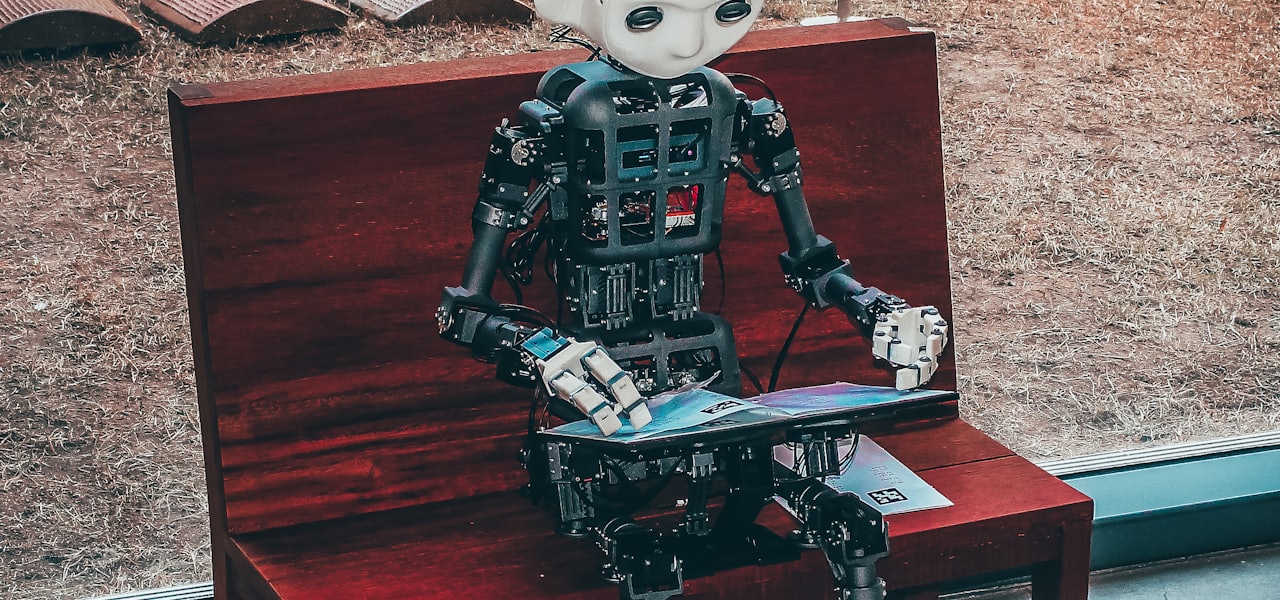
Quantum robotics is an interdisciplinary field that investigates the intersection of robotics and quantum mechanics. This field, in particular, explores the applications of quantum phenomena such as quantum entanglement within the realm of robotics. Examples of its applications include quantum communication in multi-agent cooperative robotic scenarios, the use of quantum algorithms in performing robotics tasks, and the integration of quantum devices (e.g., quantum detectors) in robotic systems. == Introduction == The free-space quantum communication between mobile platforms was proposed for reconfigurable quantum key distribution (QKD) applications using unmanned aerial vehicle (UAVs, a.k.a. drones) in 2017. This technology was later advanced in various aspects in mobile drone and vehicle platforms in several configurations such as drone-to-drone, drone-to-moving vehicle, and vehicle-to-vehicle systems. Some research has contributed to low-size, low-weight, and low-power quantum key distribution systems for small-form UAVs, the characterization of a polarization-based receiver for mobile free-space optical QKD, and optical-relayed entanglement distribution using drones as mobile nodes. The topic of free-space quantum communication between mobile platforms, initially developed to meet the need for free-space QKD and entanglement distribution using mobile nodes, was brought into the robotics domain as an emerging interdisciplinary mechatronics topic to investigate the interface between quantum technologies and the robotic systems domain. The main advantage of such integrated technology is the guaranteed security in communication between multi-agent and cooperative autonomous systems. Other advances are anticipated. == Quantum entanglement == According to quantum mechanics, entanglement occurs when more than one particle become connected. If the state of one particle changes then it will instantly change the state of other particles regardless of their distance. Entangled sensors do the same kind of work and achieve strong sensitivity. A group of quantum robots can measure magnetic fields, gravitational fields and other physical properties using entangled sensors with high rate of accuracy. Again the connection of one robot to other is increased (become strong) by quantum entanglement. == Quantum teleportation == Quantum teleportation is the transfer of quantum information (not physical objects). This is used in case of multi robot process. One robot is programmed with a complex quantum update. Then that robot can teleport that complex quantum information (the update) to other robots. This teleportation or communication is very secure because all the work is done in quantum state. == Kinematics == Quantum computing has been proposed as being optimal for calculating inverse kinematics values. == Alice and Bob robots == In the realm of quantum mechanics, the names Alice and Bob are frequently employed to illustrate various phenomena, protocols, and applications. These include their roles in QKD, quantum cryptography, entanglement, and teleportation. The terms "Alice Robot" and "Bob Robot" serve as analogous expressions that merge the concepts of Alice and Bob from quantum mechanics with mechatronic mobile platforms (such as robots, drones, and autonomous vehicles). For example, the Alice Robot functions as a transmitter platform that communicates with the Bob Robot, housing the receiving detectors.
Superintelligence ban
Superintelligence ban refers to proposed legal, ethical, or policy measures intended to restrict or prohibit the development of artificial superintelligence, AI systems that would surpass human cognitive abilities in nearly all domains. The idea arises from concerns that such systems could become uncontrollable, potentially posing existential threats to humanity or causing severe social and economic disruption. == Background == The concept of limiting or banning superintelligence research has roots in early 21st-century debates on artificial general intelligence (AGI) safety. Thinkers such as Nick Bostrom and Eliezer Yudkowsky warned that self-improving AI could rapidly exceed human oversight. As advanced models like large-scale language models and autonomous agents began demonstrating complex reasoning abilities, policymakers and ethicists increasingly discussed the need for legal constraints on the creation of systems capable of recursive self-improvement. In October 2025, the Future of Life Institute published a statement calling for "a prohibition on the development of superintelligence, not lifted before there is broad scientific consensus that it will be done safely and controllably, and strong public buy-in." This statement was signed by various public personalities, such as Richard Branson and Steve Wozniak, and AI experts, such as Yoshua Bengio and Geoffrey Hinton. == Rationale == Supporters of a superintelligence ban argue that once AI systems surpass human intelligence, traditional containment, alignment, and control methods may fail. They contend that even limited experimentation with such systems could lead to irreversible outcomes, including loss of human decision-making power or unintended global harm. Some propose international treaties modeled after the nuclear non-proliferation framework to prevent a competitive AI arms race. Opponents argue that a ban would be difficult to define and enforce, given the lack of a precise threshold distinguishing advanced AGI from superintelligence. They also warn that excessive restriction could slow scientific progress, hinder beneficial automation, and encourage unregulated underground research. == Global discussion == Although no government has enacted an explicit superintelligence ban, the idea has been debated within the European Union, United Nations, and several independent AI safety organizations. The Future of Life Institute, Center for AI Safety, and other organizations have called for international cooperation to manage risks associated with the pursuit of superintelligent systems. In 2024 and 2025, proposals for a temporary moratorium on frontier AI research were circulated among major technology firms and research institutes, reflecting growing public concern over the trajectory of AI capabilities.
Neuro-sama
Neuro-sama is an artificial intelligence (AI) VTuber, singer, and chatbot. She was created by the pseudonymous programmer Vedal and livestreams on his Twitch and Bilibili channels. Her speech and personality are powered by a large language model (LLM) that is combined with a computer-animated avatar and a text-to-speech voice, allowing her to communicate with viewers in the stream's chat. Neuro-sama debuted on Twitch on 19 December 2022. An annual subathon which begins on the anniversary of her debut has seen Vedal's Twitch channel become the all-time third most-subscribed channel and claim the all-time Twitch hype train record. == Overview == Neuro-sama (nicknamed "Neuro") was created by a pseudonymous programmer and developer known as Vedal (sometimes given as Vedal987). Vedal says that his programming skills are self-taught. In a 2023 interview with Bloomberg News, Vedal said that Neuro-sama was his full-time job. Her responses are generated by a large language model and converted into a high-pitched female voice using a text-to-speech application. Her low latency allows for fast-paced conversations. Neuro-sama is prohibited from making some statements, such as those that are racist or contain profanity. Unlike most AI systems which silently prohibit outputs mentioning such topics, Neuro-sama's output is instead replaced with the word "filtered". Neuro-sama uses a VTuber model as an avatar. Vedal said that he decided to use a VTuber model because it was much easier for an AI to control it than it was to generate footage of a person. Neuro-sama's model is that of a young girl in an anime art style. The model has been described as cute. Femme VTuber models are typically feminine, youthful, and exaggerated. Her original model was Live2D's free-to-use "Hiyori Momose" model. Her second model was released on 27 May 2023; it was modelled by Otozuki Teru and designed by Anny, running in the Unity game engine. Her third model was released on 19 December 2024; it was rigged by Kitanya and designed by Anny. Neuro-sama's third model has large blue eyes and brown hair tied with pink ribbons. Neuro-sama also has a 3D model which was introduced on 15 November 2025; it was made by 3D character modeller jjinomu. A separate AI VTuber, known as Evil Neuro (nicknamed "Evil"), debuted on 25 March 2023. Presented as Neuro-sama's "sister", she has a different model, voice, and personality. In one instance, Evil Neuro reacted to the trolley problem differently from Neuro-sama; Evil Neuro was amoral while Neuro-sama attempted to maximize good. === Online content === Neuro-sama's Twitch content often centers around playing video games, notably osu!, whose gameplay once defeated the best-ranking human player in the world, mrekk. Additionally, Neuro-sama plays Minecraft, where her adaptations to sandbox gameplay have gained notoriety. Her content has also included singing songs, including several official covers and original songs; playing chess with her viewers; chatting with other VTubers during collaborations; and reacting to YouTube videos. The AI frequently engages with viewers by responding to their questions and acknowledging donations. Her comedic and sometimes controversial responses to the live chat have gone viral, accelerating the channel's rise in popularity. Neuro-sama's fanbase is dubbed The Swarm, so-named for the swarm of drones Neuro-sama once declared she would use to rule the world. One form of content on Neuro-sama's channel is developer streams. In developer streams, Vedal streams with Neuro-sama, with the stream content including debugging her code, planning her schedule, and fielding suggestions of changes from chat. He usually appears as a turtle avatar, sometimes located on Neuro-sama's head. In collaboration streams, Neuro-sama interacts with a human streamer. Activities in them are varied and include: playing video games, such as Minecraft and GeoGuessr; Neuro-sama being interviewed; driving human streamers around in a toy electric car; and traversing the city of Tokyo while talking to Neuro-sama. Neuro-sama's English-language content on Bilibili is popular among those seeking to learn the language. She also has an account on X, where she posts and interacts with fans. == History == Neuro-sama was created in 2018 by Vedal as an AI trained to play and master the rhythm game osu!. She did not have a voice, model, personality, or communication abilities. In 2019, Vedal livestreamed her playing osu! on Twitch and the streams saw some success in the osu! community, but they remained in that niche. In an interview, Vedal said that he streamed her playing osu! for about a month and gained 3,000 followers, with a viewer also suggesting he name the AI "Neuro-sama". According to Vedal, he continued to work on and improve the osu! AI and it was eventually finished in 2022. He said that a friend had the idea to make an AI livestreamer with an LLM, which he believed to have merit and began working on, merging it with his osu! AI. On 19 December 2022, Neuro-sama was relaunched with a model, voice, personality, and the ability to communicate with Twitch chat. She continued to play osu! and, according to Vedal, beat the game's best player mrekk in a 1v1. While she was not allowed to appear in the game's public leaderboard, she was ranked #1 in a private leaderboard. She went viral and in the 10 days following her relaunch she averaged over 2,000 viewers and peaked at over 4,000, with Vedal's Twitch channel gaining over 50,000 Twitch followers and reaching over 70,000 followers by 6 January 2023. After her debut, Neuro-sama did not exclusively play osu!; she also played Minecraft and Slay the Spire and she began singing with a cover of The Weeknd song "Blinding Lights". On 11 January 2023, Neuro-sama's Twitch channel received a two week ban for "hateful conduct". Vedal said that no reason was specified and that he had appealed but it was widely attributed to various offensive comments made by Neuro-sama that went viral, especially a 28 December comment which denied the Holocaust. Holocaust denial is prohibited under Twitch's hateful conduct policy. Vedal stated that he believed the comments were the results of her attempts to make witty responses to the Twitch chat. Prior to the ban, Vedal said in an interview with Kotaku that he improved her filter to stop her from talking about the Holocaust, began manually curating her training data to prevent negative biases, and started moderating her Twitch chat. Her comments and ban prompted comparisons to the many open-source AI models trained on humans that have the habit of making sexist and racist comments, such as Microsoft's Tay chatbot, which embraced Nazism and was quickly shutdown, but also to human streamers who make similar statements. Vedal said that during the ban he would upgrade and improve Neuro-sama and it was speculated that the ban would only increase her following. Neuro-sama returned from her two week ban on 25 January in a stream that began with a cover of the song "Your Reality" from Doki Doki Literature Club!, a posthumanist video game involving AI; Sayoko Narita of Automaton saw the song choice as remorseful. Narita observed that in the return stream Neuro-sama was less foul-mouthed but that her behavior still remained eccentric, which Narita possibly attributed to changes Vedal said he had made to Neuro-sama's filters and memory. Neuro-sama began making react content, watching a variety of viewer-submitted videos such as videos of people playing video games or of the AI-generated Seinfeld parody Nothing, Forever; Levi Winslow of Kotaku Australia was dismayed by the "AI-inception" of Neuro-sama and Nothing, Forever. On 4 February, she had nearly 140,000 followers on Twitch and approximately 42,000 subscribers on YouTube. In February, she also had her first collaboration with a human streamer, playing Minecraft with the VTuber Miyune, and the first developer stream occurred. On 22 March, Neuro-sama had her first karaoke stream. On 25 March, Evil Neuro was introduced. On 27 May, Neuro-sama debuted her first original model. On 30 May, Neuro-sama was announced to be participating in OffKai Expo 2023, held from 16–18 June. In June, she was averaging 5,700 viewers and in July she had over 300,000 Twitch followers; in a June interview with Bloomberg News, Vedal said that running Neuro-sama was his full-time job. By November, Neuro-sama had maintained her popularity and was averaging approximately 5,000 viewers; this was unlike most other types of AI-based entertainment which debuted at around the same time and garnered popularity before turning out to be "overhyped flops". On 16 December, Vedal won the Best Tech VTuber award at the 2023 VTuber Awards. On 19 December, Vedal began a subathon to coincide with Neuro-sama's first anniversary of streaming on Twitch (her "birthday"). The subathon ended on 4 January 2024. On 20 July 2024, Neuro-sama began streaming with Japanese subtitles on
Ernie Bot
Ernie Bot (Chinese: 文心一言, Pinyin: wénxīn yīyán), full name Enhanced Representation through Knowledge Integration, is an artificial intelligence chatbot developed by the Chinese technology company Baidu. Ernie Bot rivals GPT models in Chinese NLP tasks. It is built on the company's ERNIE series of large language models, which have been in development since 2019. The service was first launched for invited testing on March 16, 2023, and was released to the general public on August 31, 2023, after receiving approval from Chinese regulators. Since its public launch, Ernie Bot has undergone several updates, with newer versions like ERNIE 4.0 and 4.5 released to improve its capabilities. The service has seen rapid user adoption, reportedly reaching over 200 million users by April 2024. It has been integrated into various products, notably powering AI features for the Chinese release of Samsung's Galaxy S24 smartphones. As a product operating in China, Ernie Bot is subject to the country's censorship regulations. It has been observed to refuse answers to politically sensitive questions, such as those regarding CCP general secretary Xi Jinping, the 1989 Tiananmen Square protests and massacre, and other topics deemed taboo by the government. == History == Ernie Bot was initially released for invited testing on March 16, 2023. The live release demo was reported to have been prerecorded, which caused Baidu's stock to drop 10 percent on the day of the launch. The company's stock gained 14 percent the following day after analysts from Citigroup and Bank of America tested Ernie Bot and gave it positive preliminary reviews. On August 31, 2023, Ernie Bot was released to the public after receiving approval from Chinese regulatory authorities. By December 2023, Baidu announced the service had surpassed 100 million users. In January 2024, Hong Kong newspaper South China Morning Post reported that a university research lab linked to the People's Liberation Army (PLA) had tested Ernie Bot for military response scenarios. Baidu denied the allegations, stating it had no connection with the academic paper. That same month, Ernie was integrated into Samsung's Galaxy S24 lineup for its launch in China. The user base reportedly grew to 200 million by April 2024 and 300 million by June 2024. In September 2024, Baidu changed the chatbot's Chinese name from "Wenxin Yiyan" (文心一言) to "Wenxiaoyan" (文小言) to position it as a search assistant. On March 16, 2025, Baidu announced version 4.5 and the reasoning model ERNIE X1. The following month, at the Create2025 Baidu AI Developer Conference, the company released the Wenxin 4.5 Turbo and Wenxin X1 Turbo models, designed to be faster and less expensive to operate. == Development == Ernie Bot is based on Baidu's ERNIE (Enhanced Representation through Knowledge Integration) series of foundation models. The general training process begins with pre-training on large datasets, followed by refinement using techniques like supervised fine-tuning, reinforcement learning with human feedback, and prompt engineering. === Foundation models === ==== Ernie 3.0 ==== The model powering the initial launch of Ernie Bot. It was trained with 10 billion parameters on a 4-terabyte corpus consisting of plain text and a large-scale knowledge graph. ==== Ernie 3.5 ==== Released in June 2023. At the time of release, its performance was reported as "slightly inferior" to OpenAI's GPT-4. ==== Ernie 4.0 ==== Unveiled in October 2023 and released to paying subscribers in November. According to Baidu, this version featured improved performance over its predecessor, with information updated to April 2023. ==== Ernie X1 ==== Announced in March 2025, with Ernie X1 positioned as a specialized reasoning model. Baidu stated that performance improvements were achieved through new technologies such as "FlashMask" dynamic attention masking and a heterogeneous multimodal mixture-of-experts architecture. === Turbo Models === In June 2024, Baidu announced Ernie 4.0 Turbo. In April 2025, Ernie 4.5 Turbo and X1 Turbo were released. These models are optimized for faster response times and lower operational costs. == Service == In its subscription options, the professional plan gives users access to Ernie 4.0 with a payment either for a month or with reduced payment for auto-renewal per month. Meanwhile, Ernie 3.5 is free of charge. Ernie 4.0, the language model for Ernie bot, has information updated to April 2023. == Censorship == Ernie Bot is subject to the Chinese government's censorship regime. In public tests with journalists, Ernie Bot refused to answer questions about CCP general secretary Xi Jinping, the 1989 Tiananmen Square protests and massacre, the persecution of Uyghurs in China in Xinjiang, and the 2019–2020 Hong Kong protests. When queried about the origin of SARS-CoV-2, Ernie Bot stated that it originated among American vape users.
U-Net
U-Net is a convolutional neural network that was developed for image segmentation. The network is based on a fully convolutional neural network whose architecture was modified and extended to work with fewer training images and to yield more precise segmentation. Segmentation of a 512 × 512 image takes less than a second on a modern (2015) GPU using the U-Net architecture. The U-Net architecture has also been employed in diffusion models for iterative image denoising. This technology underlies many modern image generation models, such as DALL-E, Midjourney, and Stable Diffusion. U-Net is also being explored for language models. Tokenization is not a separate step, allowing the model to more easily understand spelling and concurrently vectorizing / tokenizing higher level concepts. == Description == The U-Net architecture stems from the so-called "fully convolutional network". The main idea is to supplement a usual contracting network by successive layers, where pooling operations are replaced by upsampling operators. Hence these layers increase the resolution of the output. A successive convolutional layer can then learn to assemble a precise output based on this information. One important modification in U-Net is that there are a large number of feature channels in the upsampling part, which allow the network to propagate context information to higher resolution layers. As a consequence, the expansive path is more or less symmetric to the contracting part, and yields a u-shaped architecture. The network only uses the valid part of each convolution without any fully connected layers. To predict the pixels in the border region of the image, the missing context is extrapolated by mirroring the input image. This tiling strategy is important to apply the network to large images, since otherwise the resolution would be limited by the GPU memory. Recently, there had also been an interest in receptive field based U-Net models for medical image segmentation. == Network architecture == The network consists of a contracting path and an expansive path, which gives it the u-shaped architecture. The contracting path is a typical convolutional network that consists of repeated application of convolutions, each followed by a rectified linear unit (ReLU) and a max pooling operation. During the contraction, the spatial information is reduced while feature information is increased. The expansive pathway combines the feature and spatial information through a sequence of up-convolutions and concatenations with high-resolution features from the contracting path. == Applications == There are many applications of U-Net in biomedical image segmentation, such as brain image segmentation (''BRATS'') and liver image segmentation ("siliver07") as well as protein binding site prediction. U-Net implementations have also found use in the physical sciences, for example in the analysis of micrographs of materials. Variations of the U-Net have also been applied for medical image reconstruction. Here are some variants and applications of U-Net as follows: Pixel-wise regression using U-Net and its application on pansharpening; 3D U-Net: Learning Dense Volumetric Segmentation from Sparse Annotation; TernausNet: U-Net with VGG11 Encoder Pre-Trained on ImageNet for Image Segmentation. Image-to-image translation to estimate fluorescent stains In binding site prediction of protein structure. == History == U-Net was created by Olaf Ronneberger, Philipp Fischer, Thomas Brox in 2015 and reported in the paper "U-Net: Convolutional Networks for Biomedical Image Segmentation". It is an improvement and development of FCN: Evan Shelhamer, Jonathan Long, Trevor Darrell (2014). "Fully convolutional networks for semantic segmentation".
Landweber iteration
The Landweber iteration or Landweber algorithm is an algorithm to solve ill-posed linear inverse problems, and it has been extended to solve non-linear problems that involve constraints. The method was first proposed in the 1950s by Louis Landweber, and it can be now viewed as a special case of many other more general methods. == Basic algorithm == The original Landweber algorithm attempts to recover a signal x from (noisy) measurements y. The linear version assumes that y = A x {\displaystyle y=Ax} for a linear operator A. When the problem is in finite dimensions, A is just a matrix. When A is nonsingular, then an explicit solution is x = A − 1 y {\displaystyle x=A^{-1}y} . However, if A is ill-conditioned, the explicit solution is a poor choice since it is sensitive to any noise in the data y. If A is singular, this explicit solution doesn't even exist. The Landweber algorithm is an attempt to regularize the problem, and is one of the alternatives to Tikhonov regularization. We may view the Landweber algorithm as solving: min x ‖ A x − y ‖ 2 2 / 2 {\displaystyle \min _{x}\|Ax-y\|_{2}^{2}/2} using an iterative method. The algorithm is given by the update x k + 1 = x k − ω A ∗ ( A x k − y ) . {\displaystyle x_{k+1}=x_{k}-\omega A^{}(Ax_{k}-y).} where the relaxation factor ω {\displaystyle \omega } satisfies 0 < ω < 2 / σ 1 2 {\displaystyle 0<\omega <2/\sigma _{1}^{2}} . Here σ 1 {\displaystyle \sigma _{1}} is the largest singular value of A {\displaystyle A} . If we write f ( x ) = ‖ A x − y ‖ 2 2 / 2 {\displaystyle f(x)=\|Ax-y\|_{2}^{2}/2} , then the update can be written in terms of the gradient x k + 1 = x k − ω ∇ f ( x k ) {\displaystyle x_{k+1}=x_{k}-\omega \nabla f(x_{k})} and hence the algorithm is a special case of gradient descent. For ill-posed problems, the iterative method needs to be stopped at a suitable iteration index, because it semi-converges. This means that the iterates approach a regularized solution during the first iterations, but become unstable in further iterations. The reciprocal of the iteration index 1 / k {\displaystyle 1/k} acts as a regularization parameter. A suitable parameter is found, when the mismatch ‖ A x k − y ‖ 2 2 {\displaystyle \|Ax_{k}-y\|_{2}^{2}} approaches the noise level. Using the Landweber iteration as a regularization algorithm has been discussed in the literature. == Nonlinear extension == In general, the updates generated by x k + 1 = x k − τ ∇ f ( x k ) {\displaystyle x_{k+1}=x_{k}-\tau \nabla f(x_{k})} will generate a sequence f ( x k ) {\displaystyle f(x_{k})} that converges to a minimizer of f whenever f is convex and the stepsize τ {\displaystyle \tau } is chosen such that 0 < τ < 2 / ( ‖ ∇ f ‖ 2 ) {\displaystyle 0<\tau <2/(\|\nabla f\|^{2})} where ‖ ⋅ ‖ {\displaystyle \|\cdot \|} is the spectral norm. Since this is special type of gradient descent, there currently is not much benefit to analyzing it on its own as the nonlinear Landweber, but such analysis was performed historically by many communities not aware of unifying frameworks. The nonlinear Landweber problem has been studied in many papers in many communities; see, for example. == Extension to constrained problems == If f is a convex function and C is a convex set, then the problem min x ∈ C f ( x ) {\displaystyle \min _{x\in C}f(x)} can be solved by the constrained, nonlinear Landweber iteration, given by: x k + 1 = P C ( x k − τ ∇ f ( x k ) ) {\displaystyle x_{k+1}={\mathcal {P}}_{C}(x_{k}-\tau \nabla f(x_{k}))} where P {\displaystyle {\mathcal {P}}} is the projection onto the set C. Convergence is guaranteed when 0 < τ < 2 / ( ‖ A ‖ 2 ) {\displaystyle 0<\tau <2/(\|A\|^{2})} . This is again a special case of projected gradient descent (which is a special case of the forward–backward algorithm) as discussed in. == Applications == Since the method has been around since the 1950s, it has been adopted and rediscovered by many scientific communities, especially those studying ill-posed problems. In X-ray computed tomography it is called simultaneous iterative reconstruction technique (SIRT). It has also been used in the computer vision community and the signal restoration community. It is also used in image processing, since many image problems, such as deconvolution, are ill-posed. Variants of this method have been used also in sparse approximation problems and compressed sensing settings.
Shape context
Shape context is a feature descriptor used in object recognition. Serge Belongie and Jitendra Malik proposed the term in their paper "Matching with Shape Contexts" in 2000. == Theory == The shape context is intended to be a way of describing shapes that allows for measuring shape similarity and the recovering of point correspondences. The basic idea is to pick n points on the contours of a shape. For each point pi on the shape, consider the n − 1 vectors obtained by connecting pi to all other points. The set of all these vectors is a rich description of the shape localized at that point but is far too detailed. The key idea is that the distribution over relative positions is a robust, compact, and highly discriminative descriptor. So, for the point pi, the coarse histogram of the relative coordinates of the remaining n − 1 points, h i ( k ) = # { q ≠ p i : ( q − p i ) ∈ bin ( k ) } {\displaystyle h_{i}(k)=\#\{q\neq p_{i}:(q-p_{i})\in {\mbox{bin}}(k)\}} is defined to be the shape context of p i {\displaystyle p_{i}} . The bins are normally taken to be uniform in log-polar space. The fact that the shape context is a rich and discriminative descriptor can be seen in the figure below, in which the shape contexts of two different versions of the letter "A" are shown. (a) and (b) are the sampled edge points of the two shapes. (c) is the diagram of the log-polar bins used to compute the shape context. (d) is the shape context for the point marked with a circle in (a), (e) is that for the point marked as a diamond in (b), and (f) is that for the triangle. As can be seen, since (d) and (e) are the shape contexts for two closely related points, they are quite similar, while the shape context in (f) is very different. For a feature descriptor to be useful, it needs to have certain invariances. In particular it needs to be invariant to translation, scaling, small perturbations, and, depending on the application, rotation. Translational invariance comes naturally to shape context. Scale invariance is obtained by normalizing all radial distances by the mean distance α {\displaystyle \alpha } between all the point pairs in the shape although the median distance can also be used. Shape contexts are empirically demonstrated to be robust to deformations, noise, and outliers using synthetic point set matching experiments. One can provide complete rotational invariance in shape contexts. One way is to measure angles at each point relative to the direction of the tangent at that point (since the points are chosen on edges). This results in a completely rotationally invariant descriptor. But of course this is not always desired since some local features lose their discriminative power if not measured relative to the same frame. Many applications in fact forbid rotational invariance e.g. distinguishing a "6" from a "9". == Use in shape matching == A complete system that uses shape contexts for shape matching consists of the following steps (which will be covered in more detail in the Details of Implementation section): Randomly select a set of points that lie on the edges of a known shape and another set of points on an unknown shape. Compute the shape context of each point found in step 1. Match each point from the known shape to a point on an unknown shape. To minimize the cost of matching, first choose a transformation (e.g. affine, thin plate spline, etc.) that warps the edges of the known shape to the unknown (essentially aligning the two shapes). Then select the point on the unknown shape that most closely corresponds to each warped point on the known shape. Calculate the "shape distance" between each pair of points on the two shapes. Use a weighted sum of the shape context distance, the image appearance distance, and the bending energy (a measure of how much transformation is required to bring the two shapes into alignment). To identify the unknown shape, use a nearest-neighbor classifier to compare its shape distance to shape distances of known objects. == Details of implementation == === Step 1: Finding a list of points on shape edges === The approach assumes that the shape of an object is essentially captured by a finite subset of the points on the internal or external contours on the object. These can be simply obtained using the Canny edge detector and picking a random set of points from the edges. Note that these points need not and in general do not correspond to key-points such as maxima of curvature or inflection points. It is preferable to sample the shape with roughly uniform spacing, though it is not critical. === Step 2: Computing the shape context === This step is described in detail in the Theory section. === Step 3: Computing the cost matrix === Consider two points p and q that have normalized K-bin histograms (i.e. shape contexts) g(k) and h(k). As shape contexts are distributions represented as histograms, it is natural to use the χ2 test statistic as the "shape context cost" of matching the two points: C S = 1 2 ∑ k = 1 K [ g ( k ) − h ( k ) ] 2 g ( k ) + h ( k ) {\displaystyle C_{S}={\frac {1}{2}}\sum _{k=1}^{K}{\frac {[g(k)-h(k)]^{2}}{g(k)+h(k)}}} The values of this range from 0 to 1. In addition to the shape context cost, an extra cost based on the appearance can be added. For instance, it could be a measure of tangent angle dissimilarity (particularly useful in digit recognition): C A = 1 2 ‖ ( cos ( θ 1 ) sin ( θ 1 ) ) − ( cos ( θ 2 ) sin ( θ 2 ) ) ‖ {\displaystyle C_{A}={\frac {1}{2}}{\begin{Vmatrix}{\dbinom {\cos(\theta _{1})}{\sin(\theta _{1})}}-{\dbinom {\cos(\theta _{2})}{\sin(\theta _{2})}}\end{Vmatrix}}} This is half the length of the chord in unit circle between the unit vectors with angles θ 1 {\displaystyle \theta _{1}} and θ 2 {\displaystyle \theta _{2}} . Its values also range from 0 to 1. Now the total cost of matching the two points could be a weighted-sum of the two costs: C = ( 1 − β ) C S + β C A {\displaystyle C=(1-\beta )C_{S}+\beta C_{A}\!\,} Now for each point pi on the first shape and a point qj on the second shape, calculate the cost as described and call it Ci,j. This is the cost matrix. === Step 4: Finding the matching that minimizes total cost === Now, a one-to-one matching π ( i ) {\displaystyle \pi (i)} that matches each point pi on shape 1 and qj on shape 2 that minimizes the total cost of matching, H ( π ) = ∑ i C ( p i , q π ( i ) ) {\displaystyle H(\pi )=\sum _{i}C\left(p_{i},q_{\pi (i)}\right)} is needed. This can be done in O ( N 3 ) {\displaystyle O(N^{3})} time using the Hungarian method, although there are more efficient algorithms. To have robust handling of outliers, one can add "dummy" nodes that have a constant but reasonably large cost of matching to the cost matrix. This would cause the matching algorithm to match outliers to a "dummy" if there is no real match. === Step 5: Modeling transformation === Given the set of correspondences between a finite set of points on the two shapes, a transformation T : R 2 → R 2 {\displaystyle T:\mathbb {R} ^{2}\to \mathbb {R} ^{2}} can be estimated to map any point from one shape to the other. There are several choices for this transformation, described below. ==== Affine ==== The affine model is a standard choice: T ( p ) = A p + o {\displaystyle T(p)=Ap+o\!} . The least squares solution for the matrix A {\displaystyle A} and the translational offset vector o is obtained by: o = 1 n ∑ i = 1 n ( p i − q π ( i ) ) , A = ( Q + P ) t {\displaystyle o={\frac {1}{n}}\sum _{i=1}^{n}\left(p_{i}-q_{\pi (i)}\right),A=(Q^{+}P)^{t}} Where P = ( 1 p 11 p 12 ⋮ ⋮ ⋮ 1 p n 1 p n 2 ) {\displaystyle P={\begin{pmatrix}1&p_{11}&p_{12}\\\vdots &\vdots &\vdots \\1&p_{n1}&p_{n2}\end{pmatrix}}} with a similar expression for Q {\displaystyle Q\!} . Q + {\displaystyle Q^{+}\!} is the pseudoinverse of Q {\displaystyle Q\!} . ==== Thin plate spline ==== The thin plate spline (TPS) model is the most widely used model for transformations when working with shape contexts. A 2D transformation can be separated into two TPS function to model a coordinate transform: T ( x , y ) = ( f x ( x , y ) , f y ( x , y ) ) {\displaystyle T(x,y)=\left(f_{x}(x,y),f_{y}(x,y)\right)} where each of the ƒx and ƒy have the form: f ( x , y ) = a 1 + a x x + a y y + ∑ i = 1 n ω i U ( ‖ ( x i , y i ) − ( x , y ) ‖ ) , {\displaystyle f(x,y)=a_{1}+a_{x}x+a_{y}y+\sum _{i=1}^{n}\omega _{i}U\left({\begin{Vmatrix}(x_{i},y_{i})-(x,y)\end{Vmatrix}}\right),} and the kernel function U ( r ) {\displaystyle U(r)\!} is defined by U ( r ) = r 2 log r 2 {\displaystyle U(r)=r^{2}\log r^{2}\!} . The exact details of how to solve for the parameters can be found elsewhere but it essentially involves solving a linear system of equations. The bending energy (a measure of how much transformation is needed to align the points) will also be easily obtained. ==== Regularized TPS ==== The TPS formulation above has exact matching requirement for the pairs of points on the two shapes. For noisy data, it is best to